 |
| fig. 1 |
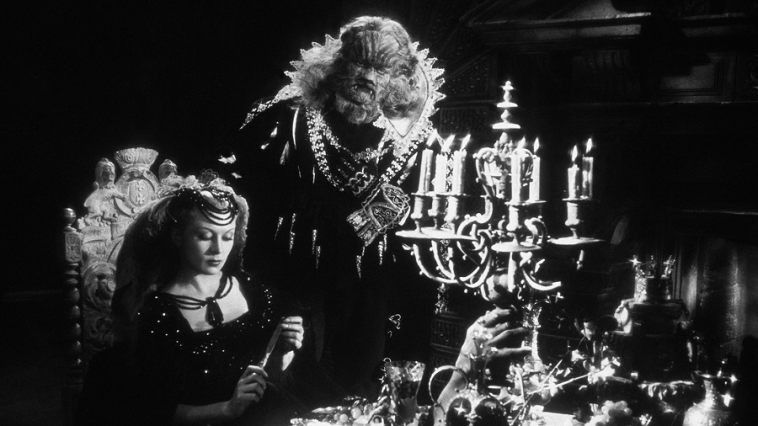
Another interpretation of the classic tale from 1757 Beauty and the Beast, La Belle et la Bête stays right by the beat with its cheesy narratives and romantic gestures wholly. it could be reminiscent of some of the old ladybird books with the kind of derived plot points it utilises of the original story. Alternatively though, this film takes a more grown up and artsy direction with the story. This is most noticeable in the scene where the father reveals the dining hall for the first time. Other differences of this film in juxtaposition with other interpretations include the factor of realism, while being a French film it takes a much more whimsical measure to the plot, it also retains the sense of individual three dimensional characters, not being as such paper cutouts as they may be shown as in an ordinary storybook. Exploration of the direction of this film will bear a great deal of experience about the relationship between inspirations and the final product.
 |
| fig 3. |
Due to its French production content is more whimsy, romantised or lovey-dovey than usual in order to appeal to their own audience.'if the sublime is to become a 'positive' experience, the mind must successfully discipline not only nature and the Imagination, but also the female other' (1) This statement is true for many cases of original tales and fables as they tend to evolve through word of mouth to adapt to different regions of the world. For example to adapt to modern interest The Wolf among Us (2013) uses a grungy realist environment to appeal to a western teenage audience, and by creating content like this the developers can maximise interest through the manipulation of subjects. Relate this back to the point of this paragraph, and you may begin to understand the basics of realism in film or other productions. If needs be to generate empathy with on screen characters it is best to utilise the idea of realism in combination with normal theatrical practise.
 |
| fig 2. |
Another thing that the movie carries well may be the relationship between man and woman, with descriptive narrative that may be traced to reveal symbolic or metaphorical insight in Freudian perspective. The beast could be seen as a predator like a man, hunting for prey, while on the other hand, Belle is the somewhat reserved, but forgiving woman that tolerates the beast and his habits. Descriptive narrative that takes this idea seriously has solid foundation in philosophy and its function, thus weaving a romantic, fantasy like setting to remember. To create a good film the entire script needs a solid ground of reality that has been thoroughly examined, be it for physical or metaphysical truths, before a director can have the confidence of the audience. This will be the empathy hook for the target group so they will go to see the film. Taking this into consideration La Belle et la Bête has confidence in its foundation and prospered thematically because of it.
 |
| fig 4. |
The attention to the costume design of beast in observation seems ridiculous by modern standards, but to tell a story, a viewer needs only to understand the form of beast rather than the aesthetic. while this may seem to be a defensive stance by point of reading, and it is a valid negative to the film despite its age it would be advisable to be at the height of understanding of the director and artistic vision himself, Jean Cocteau. Essentially being designed from the ground up with the original tale at its center, artistry is an important factor to the professional success of the title. There is a choice of scenes that may be referred to prove his vision in terms of design. 'Its entrance hall is lined with candelabra held by living human arms that extend from the walls. The statues are alive, and their eyes follow the progress of the characters' 'As Belle first enters the Beast's domain, she seems to run dreamily a few feet above the floor. Later, her feet do not move at all, but she glides, as if drawn by a magnetic force.' (2) From this we can discern a quality that may have been left unnoticed but appreciated in the form of production.
To conclude, La Belle et la Bête is a beautifully artistically envisioned piece, with particularly focus on the Freudian elements that make give it the adult edge the original Beauty and the Beast never seemed to possess. 'the latent contents of the unconscious can also register effects in consciousness by means of symbolism' (3) It was an important observation at the time that generated interest from both the professionally formed society and the public that received its message. You could say it was a natural development to adapt from a child's fiction to an adult audience. And from this content we could develop our own observation of screenplay, as to orientate our own content to suit the public more, as of course it was always intended to be.
Bibliography
(1)Shaw, Philip A.
The Sublime. 1st ed. London: Routledge, 2006. Print.
(2) Ebert, Roger. "Beauty And The Beast Movie Review (1946) | Roger Ebert".
Rogerebert.com. N.p., 2016. Web. 27 Nov. 2016.
(3) Badcock C, Essential Freud, 2nd edition, Blackwell, Oxford
Pictures
1. Beauty enters the hallway (La Belle et la Bête 1947)
2. Steam Page header for The Wolf among us (2013)
3. Movie poster for La Belle et la Bête (1946)
4. Belle and the Beast convene in the dining room (La Belle et la Bête 1946 )


No comments:
Post a Comment