
 |
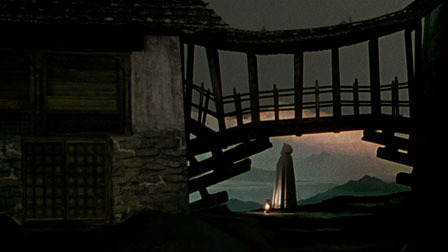
| fig 1. |
Black Narcissus is a story about four nuns who set up a nunnery in a remote location in the mountains with the intent to achieve a foundation of morals within the simple society. They intended to introduce more sophisticated morals into the lives of the community, but they were not prepared for the kind of resistance they would face, as it would seem that the people were just too simple a community to require Christian code. Key elements of the plot are explained in a number of ways by the director Micheal Powell, mostly by way of Dean, a white man living with the village prior the nuns arrival. And above all,there is a subtle but powerful drive behind the conflict, and that is a desire for sex, love or passion, that is sampled throughout the film to flavour the somewhat bland nature of the situation. This combination of elements causes the sheltered nuns to break at the seams over the course of the film, creating antagonists and protagonists alike in its wake.
 |
| fig 2. |
This film utilises philosophy and psychology of the human mind, particularly that of the female psyche, to generate conflict. There a number of times this is shown within the film, most prominently over the sequence of events that seems to transform Sister Ruth (Kathleen Byron) to her old self. Female psyche horror is dependent upon these sort of mechanics since sex is essentially the center of the plot with Freudian accuracy. 'disallowed motives remain in the repressed unconscious as long as they cannot reach conscious realisation.'(1). Nuns have a taboo representation of sex and its meaning, therefore the shock factor of the antagonist is amplified. We can safely say if anyone was inspired to make a similar experience they would need to be prepared to put in the time to study psychology before even coming close to the quality of this film. Psychological horror has prerequisites that need to be met, and this is an early representative of those important things.
This movie takes advantage of foreshadowing in the plot to narrate events that have yet to happen in the plot. When Sister Ruth puts on the red lipstick, the narrative seems to put up a symbol like seen this quote from the book Of Mice and Men, ''She had full, rouged lips and wide-spaced eyes, heavily made up. Her fingernails were red. Her hair hung in little rolled clusters, like sausages. She wore a cotton house dress and red mules, on the insteps of which were little bouquets of red ostrich feathers.'(2) Other characters in the film are related to the situations they get themselves involved in, such as the larger sister being involved with children and food production, and 'honey' being involved more socially, meaning in the film she gets the brunt of change. As a result of all this, the movie has a sense of tension building throughout up until the death scene seen through matter not directly related to the horror itself. this means that it is not necessary for horror films to directly show the main antagonist.
Usage of sublime elements combined with themes of Christianity and human nature generate similar feelings of elevation within the audience, thus creating the horror needed for this genre. 'the goal of the sublime is to sustain a sense of shock, to prevent the reader/viewer/interpreter from coming to terms with..' (3) While sublimity may be considered as a more godly theme, this version would seem more affiliated with the human nature, and its conflicting self. Outwardly there is a scene that refers to the Black Narcissus of its namesake, and how it is an expensive essence or perfume that the nuns find to be deterring, possibly because of its sexual undertone, however there is only reason to believe this from an audiences point of view, since the nuns are inherited sexual abstinence. Flashbacks, on the other hand seem to indicate their yearning of such a activity as loving, since it is something they had already committed to in the past. Putting this evidence together it is possible to conclude that the usage of the sublime element adds up to a more involved atmosphere within the narrative, again without showing the direct threat as explained in the previous point.
To conclude, 'Black Narcissus' is a good film, it sets the standards of this kind of genre and has become a classic in its own right, although sometimes the plot can be a bit slow or plodding for a horror genre, with a lot of scenes that fill in and build up to the death scene.'This burning, fervent, internal strife, builds continuously towards the film's almost gothic climax. To see the film progress from cold and indifferent to brooding and almost supernatural shows Powell's mastery of tone.'(4) a lot of mainstream people would probably go as far as to 'cut the fat' and simply show the result of the buildup as a highlight of the entire film. Which is a shame especially since the film had such a large budget in production, it came down to one scene. It is a good sample of matte painting in cinema, extending environments with simple painting techniques is knowledge that is still used in cinema today.
Bibliography
(1) Badcock, Christopher Essential Freud 2nd ed. Blackwell: Oxford , 1992, pg 133
(2) Steinback J, Of mice and Men, American Literature, 1937, Chapter 2
(3) Shaw, Philip A. The Sublime. 1st ed. London: Routledge, 2006. pg. 9
Mirasol, Michael. ""Black Narcissus," Which Electrified Scorsese | Far Flungers | Roger Ebert". Rogerebert.com. N.p., 2016. Web. 28 Nov. 2016.
Pictures
fig 1. Night time scene Black Narcissus (1947)
fig 2. Bell Ringing scene with matt painting Black Narcissus (1947)
fig 3. Front cover Of Mice and Men (1937)
fig 4. Sister Ruth plotting Black Narcissus (1947)
fig 5. Nuns having a meal Black Narcissus (1947)
 |
| fig 3. |
This movie takes advantage of foreshadowing in the plot to narrate events that have yet to happen in the plot. When Sister Ruth puts on the red lipstick, the narrative seems to put up a symbol like seen this quote from the book Of Mice and Men, ''She had full, rouged lips and wide-spaced eyes, heavily made up. Her fingernails were red. Her hair hung in little rolled clusters, like sausages. She wore a cotton house dress and red mules, on the insteps of which were little bouquets of red ostrich feathers.'(2) Other characters in the film are related to the situations they get themselves involved in, such as the larger sister being involved with children and food production, and 'honey' being involved more socially, meaning in the film she gets the brunt of change. As a result of all this, the movie has a sense of tension building throughout up until the death scene seen through matter not directly related to the horror itself. this means that it is not necessary for horror films to directly show the main antagonist.
 |
| fig 4. |
 |
| fig 5. |
Bibliography
(1) Badcock, Christopher Essential Freud 2nd ed. Blackwell: Oxford , 1992, pg 133
(2) Steinback J, Of mice and Men, American Literature, 1937, Chapter 2
(3) Shaw, Philip A. The Sublime. 1st ed. London: Routledge, 2006. pg. 9
Mirasol, Michael. ""Black Narcissus," Which Electrified Scorsese | Far Flungers | Roger Ebert". Rogerebert.com. N.p., 2016. Web. 28 Nov. 2016.
Pictures
fig 1. Night time scene Black Narcissus (1947)
fig 2. Bell Ringing scene with matt painting Black Narcissus (1947)
fig 3. Front cover Of Mice and Men (1937)
fig 4. Sister Ruth plotting Black Narcissus (1947)
fig 5. Nuns having a meal Black Narcissus (1947)
Hi Anabel,
ReplyDeleteFirstly, please read back over my previous comments on your reviews, regarding using the Harvard method to reference your sources.
Both this review and the 'Belle' one have some very interesting and valid observations, especially around Freudian theory. Be careful that your source material is relevant though - you have chosen a quote from 'Of Mice and Men', which although it ties in with use of the colour red as a symbol of sexuality, is too tenuous in this instance...
It might also have been good to expand a little on the set design - you mention the use of the matte painting, almost as an afterthought.